
Books & Courses
Books
Some of the most exciting moments in my career have come from watching an AI solve scientific problems in ways no human would have thought of, or seeing scientific principles and insights unlock new kinds of machine learning.
I've spent years living at this intersection, and recently I started writing in long form (so far in Spanish editions) about what I've seen and learned, for the science students who will have to make these tools their own, for specialists, and for anyone curious about where science is heading.
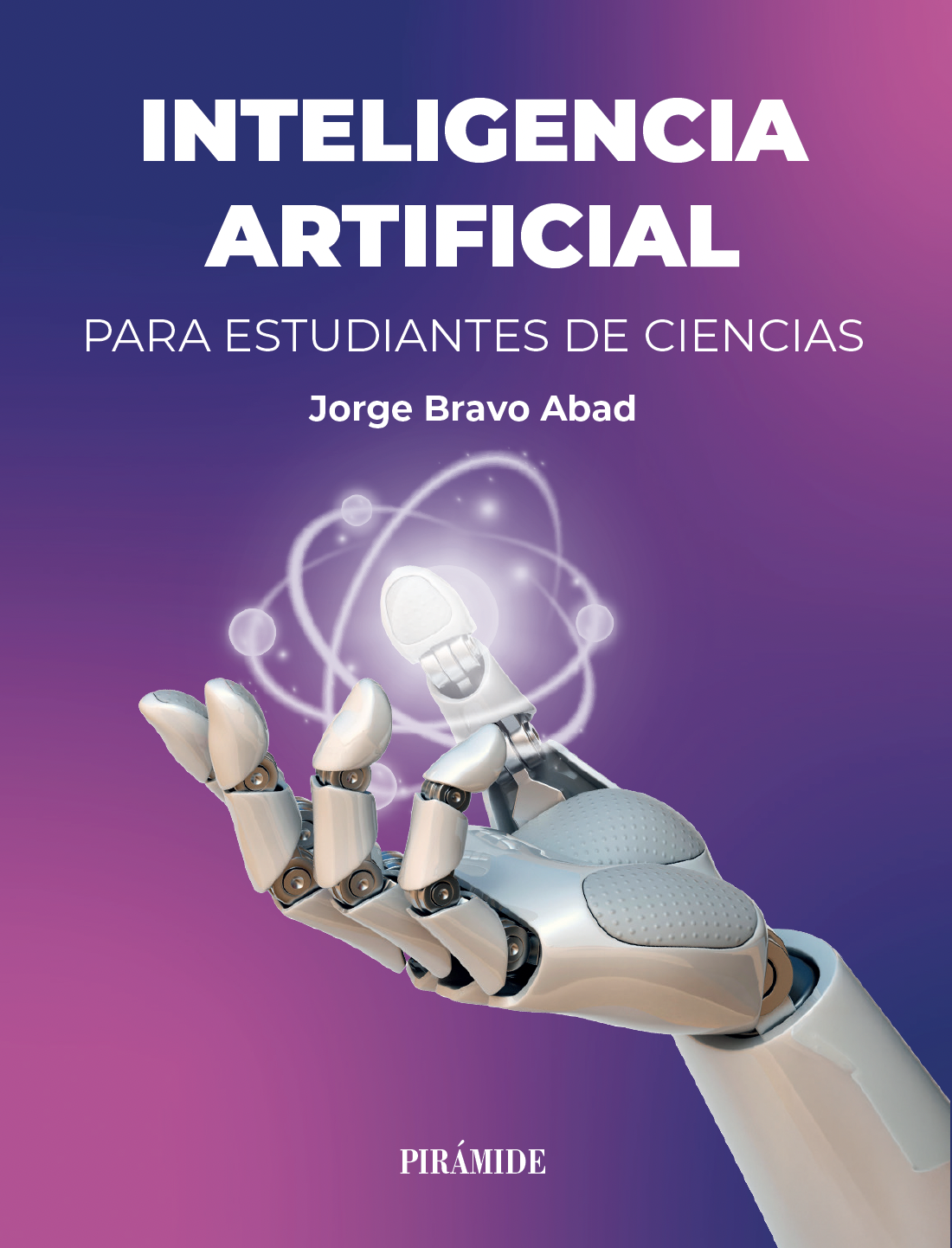
Artificial Intelligence for Scientists
(Spanish Edition)
Septiembre 2026, Ediciones Pirámide
Artificial intelligence is only useful in science when it is understood with mathematical rigor, critical judgment, and a detailed grasp of the experimental or theoretical context in which it is applied. That conviction runs through this textbook, written for advanced undergraduates, graduate students, and researchers who want to bring machine learning into their own scientific practice.
It builds up progressively from the conceptual and mathematical foundations of learning to the methods that define the field today: regression, classification, and unsupervised learning; dense, convolutional, and recurrent networks; generative models, transformers, reinforcement learning, and networks informed by scientific principles.
Two things set it apart from a general machine-learning text. It pays sustained attention to the small-data regime that characterizes much of experimental science, and it insists throughout on good practice in modeling, evaluation, and interpretability.
Theory, disciplinary intuition, and worked examples in Python with scikit-learn and PyTorch are woven together, with the aim of deep understanding rather than surface familiarity with libraries.
The book grew out of several years of teaching these courses at the Universidad Autónoma de Madrid, and is meant to be a solid bridge between traditional scientific training and the AI techniques now redefining how research is done.
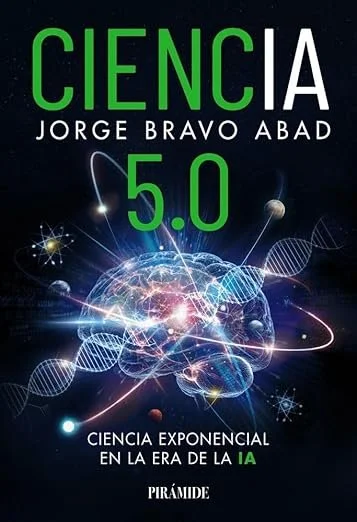
Science 5.0
(Spanish Edition)
April 2026, Ediciones Pirámide
Algorithms that predict protein structures in minutes, when it used to take years. Systems that anticipate extreme weather events with unprecedented accuracy. Robots that speed up chemical discovery by combining hypotheses and experiments. Neural networks that find mathematical proofs where there were once only conjectures. This is not science fiction or a distant promise: it is happening right now, in labs around the world.
Ciencia 5.0 guides us through this new territory with rigor and clarity. Without requiring prior knowledge, the author explains how artificial intelligence is transforming science from the inside out: how we formulate questions, analyze data, and turn information into discovery. From machine learning to the frontiers of quantum computing, from medicine to the exploration of the cosmos, the reader will tour the key ideas behind a revolution already underway.
But this book is also a reflection on what it means to be a scientist when machines become research partners; on the risks of speed without responsibility; on who signs discoveries and who benefits from them; and on how to build a more powerful science without losing its human core. The science of the future is being written now. Understanding it is the first step toward deciding, together, where we want it to take us.
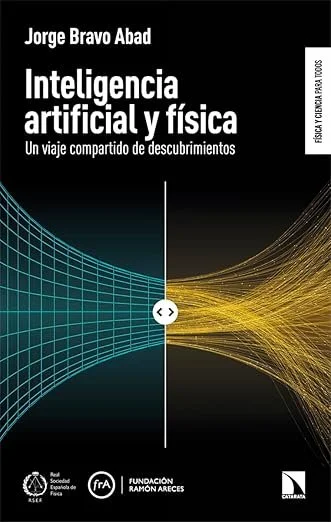
Artificial Intelligence and Physics: A Shared Journey of Discovery
(Spanish Edition)
February 2026, Editorial Los Libros de la Catarata
What do the laws that govern the universe have in common with the algorithms that allow machines to learn? Physics and artificial intelligence (AI) have long been in fruitful dialogue—one that has accelerated dramatically in recent years, reshaping how we think about nature and intelligence. How does AI open new paths in physics? How do ideas from physics shape modern machine learning? This book explores that borderland through shared concepts and intuitions: the statistical-physics foundations of AI, AI’s role in the quantum world, its contributions to large-scale data analysis in particle physics, and the promise of autonomous laboratories for discovering new materials. A journey that transcends specific technologies or fleeting advances, inviting us to rethink intelligence, matter, and the principles that connect them.
“AI for Science”courses at UAM:
Over the years, together with distinguished colleagues at Universidad Autónoma de Madrid (UAM), we have played a pivotal role in spearheading the creation and teaching of numerous courses focusing on artificial intelligence applied to scientific research.
Our efforts have spanned comprehensive graduate and undergraduate curricula, as well as specialized short courses and intensive bootcamps. We are particularly pleased that through these courses we are actively contributing on a daily basis to preparing a new generation of scientists and researchers who are now applying advanced AI methods to address significant challenges across diverse scientific disciplines.
- AI for Physics (undergraduate course in the Physics degree at UAM, 2025-)
- AI for Scientific Research (graduate course in the Master's Degree in Physics of Condensed Matter and Biological Systems at UAM, 2024-).
- AI for Scientists Bootcamp 2021 (June 2021).
- AI for Scientists Bootcamp (Oct.-Nov. 2020).
- Introduction to artificial intelligence for scientific problems (July 2020).